

In this article
I want to ask you something, and I want you to be honest with yourself when you read it.
You want to recover. You’ve read about it, watched videos about it, maybe tried a few things. And somewhere underneath all of that, there’s a part of you that’s quietly holding back.
If that’s true for you, I’m not judging it. I did the same thing. For years.
So let’s talk a little about that today.
The Back Pocket
A few years into my anxiety, I stumbled onto an overview of the method that eventually got me fully recovered. I read about it. I roughly understood the principle.
I even Googled and found someone in my own country who had gone through the exact same thing and come out the other side and was offering mentor services.
And I didn’t do anything with it.
I told myself it was because I wasn’t sure it would work.That it seemed too simple for something this big.
That it felt strange to trust someone who wasn’t a certified professional, even though I’d already spent about $20,000 on certified professionals who hadn’t fixed anything.
But honestly, underneath all of that, I was scared it wouldn’t work for me specifically.
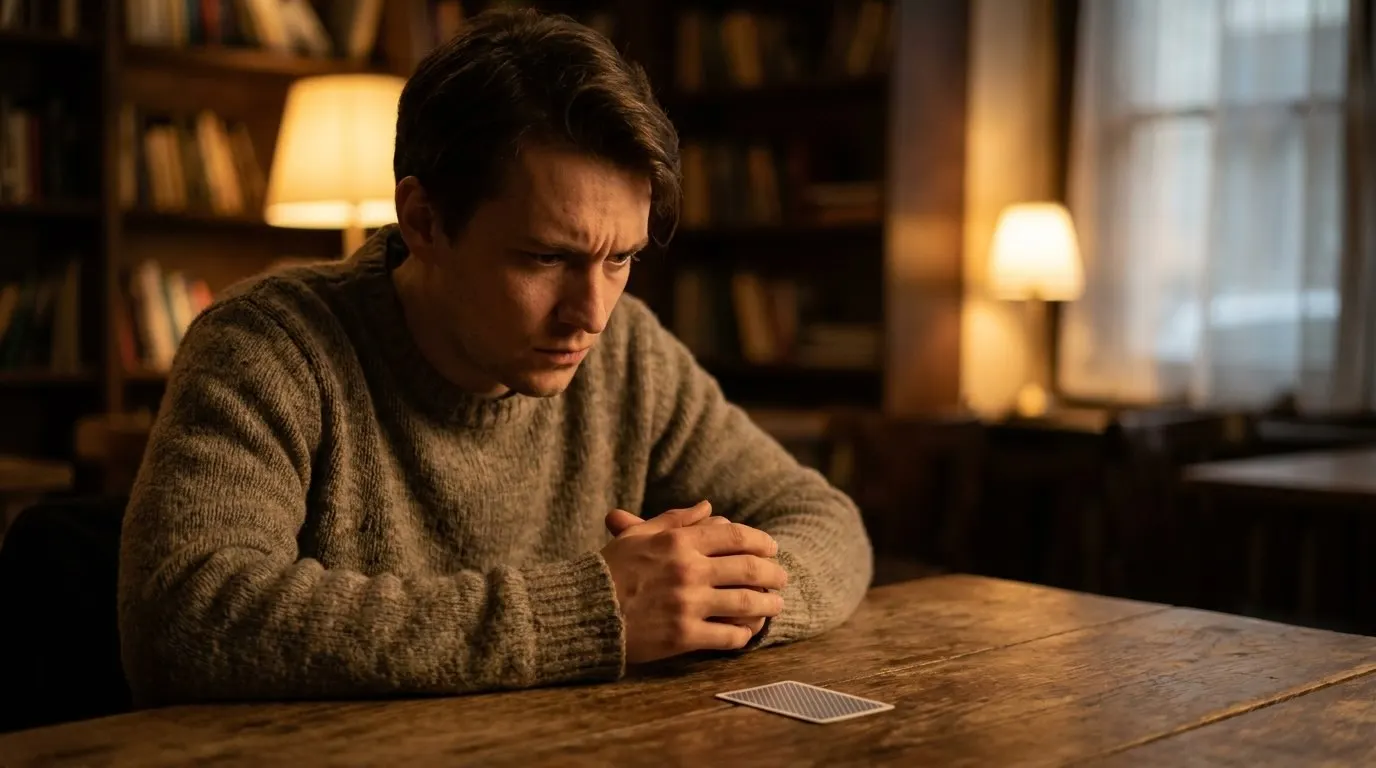
So I kept it in my back pocket. Just knowing it was there actually helped manage the anxiety for a while. Like a card I hadn’t played yet.
A new way to get reassurance.
And I held onto that card for two more years. Until my fiancée ended the engagement and my anxiety was peaking every single day, and I finally had no choice but to play it.
With full knowledge that if it didn’t work, I had no idea what I’d do next.
That was a terrifying place to be in. But here’s what I want you to understand. I wasted two years keeping that card in my pocket.
Two years of anxiety I didn’t need to have.
Why You Hold Back
When you’ve been through a lot of things that didn’t work, your brain learns from that.
It learns that hope is dangerous. That investing emotionally in something and having it fail again costs more than just the time and the money.
It costs a little more of your belief that recovery is even possible for you.
So it protects you. It keeps you half-committed. Because half-committed means half the heartbreak if it doesn’t work.
You always have the exit: “well, I didn’t really fully try.”
Full commitment removes that exit entirely. And for someone who’s been through what you’ve probably been through, removing that exit feels genuinely frightening.
And I get that. I really do. Because I was in exactly that place.
The Identity Piece
Here’s the part that most people don’t talk about, and I think it’s actually the most important one.
There’s a well-known idea in psychology around identity and consistency.
The basic principle is this: one of the strongest forces in the human mind is the need to stay consistent with how we define ourselves.
If you’ve had anxiety for five years, ten years, twenty years, it doesn’t just stay as a set of symptoms. It quietly becomes part of your identity.
You organize your life around it. You explain yourself through it. Sometimes it even meets certain needs, it can create a sense of connection with people who understand, a reason for things not working out the way you hoped, sometimes even a form of significance.
Like how I always told myself that the videos I was making as a videographer weren’t as good as my coworkers’ videos because of my anxiety. Whereas I probably could’ve done better but I was just scared.
And here’s where it gets interesting. If your identity says “I am someone with anxiety, someone who struggles with this,” then your brain will quietly work to stay consistent with that definition, even when you consciously want to change it.
This is why some people start recovering and then unconsciously sabotage it.
They start responding properly, things start shifting, and then suddenly they’re back to old safety behaviors, back to avoiding, back to fighting the sensations.
Not because the method stopped working. But because getting better feels like losing something. Like saying goodbye to a part of yourself you’ve known for a very long time.
And sometimes the question underneath it all is: if anxiety is gone, who am I then?
That’s not weakness. That’s a very human thing to experience.
It can be scary to find out.
Like on of our Mentorship clients texting me this week telling me she felt bored for the first time in a very long time. And it was strange!
Normally she was so busy fighting off anxiety or keeping busy, there was no room to be bored. And now she gave herself the permission to be bored. Anxiety is no longer calling the shots.
And that’s something unfamiliar, potentially scary, to having to deal with next.
The Subtle Ways This Shows Up
You probably won’t notice yourself getting in the way of recovery, which is why I want to name it clearly.
It looks like watching videos and reading posts for months without applying anything.
It looks like starting the steps and stopping right when things get uncomfortable.
It looks like asking a lot of questions but somehow never doing the actual work and responding.
It looks like telling yourself you’ll really commit when things calm down a bit, and things never quite calm down enough.
It looks like keeping the card in your back pocket.
Waiting for you to feel ready or confident. And that’s never going to happen.
None of this is laziness. It’s self-protection. And there’s a big difference.
You Don’t Need to Believe It Will Work First
Here’s the thing I really wish someone had told me when I was sitting on that card.
You don’t need to feel ready before you start.
You don’t need to be convinced it’s going to work. You don’t need to believe in the process before committing to it.
The belief comes after. Not before.
I actually recorded a video recently that goes deeper into exactly this. The doubt, the fear that your case is different, the skepticism that builds up after years of things not working. If that part of what I just described really resonates, watch this.

What actually changes things is what I call stacking the proof. You take action before you feel ready.
You apply the steps imperfectly, inconsistently at first, with doubt still present. And you have a small win.
Maybe anxiety showed up and you allowed it to be there instead of fighting it, and it passed.
Maybe you went somewhere you’d been avoiding and it wasn’t quite as bad as you feared.
Maybe you let a panic attack run its course without running from it and you noticed it passing on its own.
Those aren’t just wins. They’re data points. Evidence. And you stack them, one on top of another.
And somewhere along the way, without any single dramatic moment, your nervous system updates. Not because you decided to believe it, but because you’ve lived it enough times that your body actually knows it now.
That’s how it worked for me.
I didn’t go in convinced. I went in because I had no other choice. My nervous system didn’t regulate magically within a couple of weeks, but I kept applying the response any time I noticed anxiety.
And slowly, piece by piece, I started getting proof that it was actually working. Proof that I could handle the sensations. Proof that they weren’t as permanent or as all-powerful as I’d believed.
And those pieces stacked up into a belief. A real one. One I earned, not one I talked myself into.
Take Action Anyway
If you feel skeptical right now, doubtful, unsure whether this will work for you specifically, I want you to know that’s not a red flag.
That’s actually exactly where every single person I’ve ever worked with started.
Every one of them came in with doubt. Every one of them recovered.
The doubt isn’t a sign that your case is different. It’s a sign that you’ve been let down before. And that makes complete sense.
But that doubt is not a reason to wait. Ready is not something you feel first. It’s something you build by doing the thing before you feel ready for it.
So if you’ve been keeping something in your back pocket, I just want to say this.
Play the card. You don’t have to feel sure. You just have to start.
If the whole message behind anxiety recovery is “doing it anxious”, it also applies to the actual recovery journey itself.
Be anxious, uncomfortable, skeptical or uncertain, and do it anyways.
It’s worth it.
This article is for education and is based on lived experience. It is not medical advice and does not replace a doctor or therapist. If you have new or changing symptoms, get them checked by a doctor. If you are in crisis, contact your local emergency number.